 Mark Hertsgaard visited campus to speak about global warming and his book: The Eagle's Shadow. Myself and several of my colleagues were invited to a lunch-time discussion with him the following day. Most of this time consisted of Q&A. Students asked several questions mostly related to environmental awareness in the community through civic engagement. I asked him who he saw most fit to be elected, and why. He seemed quite fond of John Edwards especially due to his environmental policies, but did not seem to be particularly against Paul or Kucinich when I brought up their names. Hertsgaard, however, made pretty sure to be an "objective journalist," and remained considerably neutral on such topics. Toward the end of our chat he began to mention his next book dedicated primarily to global warming activism. His beliefs on global warming are fairly congruent with Gore's - to give you an idea. In response to his enthusiasm, I proceeded to probe for his awareness of data that supports the idea of naturally occurring global warming. I tried my best to keep the conversation away from the "this source is better than that one" argument, and move toward the specifics of data and the positivity of projections. This was the turning point that my Socratic probing made me the bad guy - I was one of the many "brainwashed" sheeple of the media; I was questioning Gore's good will and the impeccable record of the IPCC! It was my strategy to ease him into my partial skepticism so I could eventually ask: Don't you think we should be making these changes to our policies and technologies regardless of global warming's true cause? Indeed I was in for a surprise; the author of open minded ideas became visibly disturbed at my questioning of the popular opinion. Since I seemed to be less frightened of his frame than the other students - probably due to the fact that I respect him for being so right on most topics, but understand that this does not make him the final word on new scientific theories - I let him vent on me without further debate. I don't need to share all of the details, but I did thoroughly enjoyed this experience - even though most would probably have been too uncomfortable to sit in Hertsgaard's hot seat. He did apologize for losing his temper, but no worries (if you end up seeing this Mr. Hertsgaard) - I understand your good intentions. Unfortunately as you may know, especially in the political arena, we can't be too sure of intent.
Wednesday, December 12, 2007
Visited by Mark Hertsgaard
Mark Hertsgaard visited campus to speak about global warming and his book: The Eagle's Shadow. Myself and several of my colleagues were invited to a lunch-time discussion with him the following day. Most of this time consisted of Q&A. Students asked several questions mostly related to environmental awareness in the community through civic engagement. I asked him who he saw most fit to be elected, and why. He seemed quite fond of John Edwards especially due to his environmental policies, but did not seem to be particularly against Paul or Kucinich when I brought up their names. Hertsgaard, however, made pretty sure to be an "objective journalist," and remained considerably neutral on such topics. Toward the end of our chat he began to mention his next book dedicated primarily to global warming activism. His beliefs on global warming are fairly congruent with Gore's - to give you an idea. In response to his enthusiasm, I proceeded to probe for his awareness of data that supports the idea of naturally occurring global warming. I tried my best to keep the conversation away from the "this source is better than that one" argument, and move toward the specifics of data and the positivity of projections. This was the turning point that my Socratic probing made me the bad guy - I was one of the many "brainwashed" sheeple of the media; I was questioning Gore's good will and the impeccable record of the IPCC! It was my strategy to ease him into my partial skepticism so I could eventually ask: Don't you think we should be making these changes to our policies and technologies regardless of global warming's true cause? Indeed I was in for a surprise; the author of open minded ideas became visibly disturbed at my questioning of the popular opinion. Since I seemed to be less frightened of his frame than the other students - probably due to the fact that I respect him for being so right on most topics, but understand that this does not make him the final word on new scientific theories - I let him vent on me without further debate. I don't need to share all of the details, but I did thoroughly enjoyed this experience - even though most would probably have been too uncomfortable to sit in Hertsgaard's hot seat. He did apologize for losing his temper, but no worries (if you end up seeing this Mr. Hertsgaard) - I understand your good intentions. Unfortunately as you may know, especially in the political arena, we can't be too sure of intent.

Sunday, December 9, 2007
Apples to Oranges: Wikipedia and Britannica
There are many ways to approach this comparison. I could, of course, show you the endless corrections of Wikipedia that are yet to be found in Encyclopedia Britannica. Even if Britannica published new Encyclopedias everyday, and hired teams of developers to keep their online encyclopedia up to date, they could never keep as cutting edge and as current as Wikipedia. By writing this entry and elegantly integrating links from Wikipedia - I have demonstrated Wikipedia's strength as a web tool. Wikipedia is a masterful demonstration of the capabilities of new Internet generations - facilitating the ever increasing speed at which information can be shared and merged between users for the creation of even more involved collaboration and information technologies.
It is of course true that Britannica and Wikipedia have similarities. They both definitely have errors and other problems, but many times for different reasons. While Wikipedia often has a "wisdom of the mob," Britannica is commonly shown to be outdated or lacking in detail. In many cases, the wisdom of the masses is better than the wisdom of the wisdom of the “experts” because more controversy is included, but this isn't always the case. Communities of Wikipedian's even demonstrate self-censorship in many cases by excluding unpopular information. The global warming page on Wikipedia shows very little controversy, but it includes significantly more references and material (not to mention there is a specific Wikipedia page for global warming controversy) than Britannica's global warming page. Even topics like Columbus's discovery of America which still challenge popular opinion are subject to censorship – only recently has anything about Christopher Columbus's affinity for slavery been mentioned on his Wikipedia page, but Britannica's Encyclopedia doesn't mention this at all.
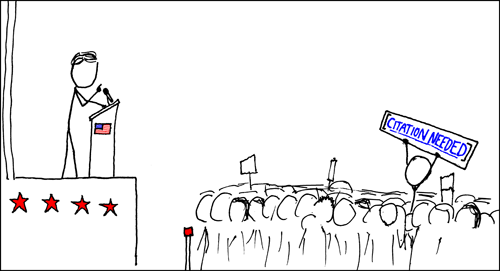
After all of the fuss in academics about copying from Wikipedia - when all that is really needed is to enforce Wikipedia's own rules of information and citation usage. (Anything is potentially inaccurate when you copy or skip over the original sources.) The culture of information accuracy is helped not hurt by the wikipedian who is humorously portrayed by as protester in my favorite cartoon xkcd. Wikipedia is both a static and dynamic source which can itself cite Britannica, and for this reason sources like Britannica are certainly still useful. As Jimmy Wales has spoken about himself: Wikipedia has the technology to document culture in a way that can give the people of the future a realistic view of what it was like to live in our culture today.
It is of course true that Britannica and Wikipedia have similarities. They both definitely have errors and other problems, but many times for different reasons. While Wikipedia often has a "wisdom of the mob," Britannica is commonly shown to be outdated or lacking in detail. In many cases, the wisdom of the masses is better than the wisdom of the wisdom of the “experts” because more controversy is included, but this isn't always the case. Communities of Wikipedian's even demonstrate self-censorship in many cases by excluding unpopular information. The global warming page on Wikipedia shows very little controversy, but it includes significantly more references and material (not to mention there is a specific Wikipedia page for global warming controversy) than Britannica's global warming page. Even topics like Columbus's discovery of America which still challenge popular opinion are subject to censorship – only recently has anything about Christopher Columbus's affinity for slavery been mentioned on his Wikipedia page, but Britannica's Encyclopedia doesn't mention this at all.
After all of the fuss in academics about copying from Wikipedia - when all that is really needed is to enforce Wikipedia's own rules of information and citation usage. (Anything is potentially inaccurate when you copy or skip over the original sources.) The culture of information accuracy is helped not hurt by the wikipedian who is humorously portrayed by as protester in my favorite cartoon xkcd. Wikipedia is both a static and dynamic source which can itself cite Britannica, and for this reason sources like Britannica are certainly still useful. As Jimmy Wales has spoken about himself: Wikipedia has the technology to document culture in a way that can give the people of the future a realistic view of what it was like to live in our culture today.
Subscribe to:
Comments (Atom)